Arquivo de Sem Categoria - Page 14 of 14 - Team Transformerz


News

GRID VIEW

No more posts
guilhermetransf-2.png

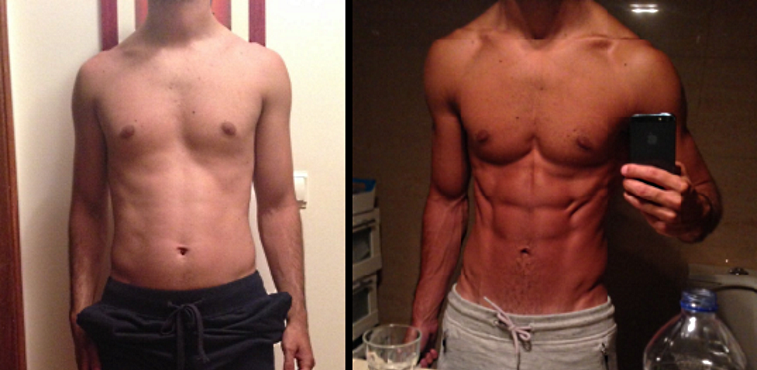
Guilherme is an example of a person who, at first glance, people would say didn’t need to go on a diet. Right? His condition was not bad.

But the thing is, when you follow a diet that’s adequate to your needs and goals, along with weight training custom to you, you can do like Guilherme did and take your body from average to incredible in just 10 weeks!

guilherme frente

Truth be told, Guilherme’s first week wasn’t the best. His adaptation to macro counting and flexible dieting wasn’t natural and demanded some effort and support. But, Guilherme didn’t give up. He clarified his doubts and got to work.

All that is necessary is dedication.

As you can see, with just a bit of effort on Guilherme’s behalf, he totally transformed his physique and all we can do is congratulate him for his excellent work.

guilherme costas

Our approach throughout the 10 weeks was as follows:

  • He started his journey weighing 64kgs. In his first week he ate 2200kcal per day and ate 3600kcal on the last day, all of these values with no restrictions in terms of macro nutrients.
  • After the third week, his average weight was 63,64kg. Here Guilherme was already being very consistent with his macros, which were: Protein: 160g Fat: 60g Carbs: 250g plus 2 “High” days of: Protein: 160g Fat: 78g Carbs: 400g
  • After the 6th week, Guilherme already showed significant progress, weighing an average of 62,95kg. His macros were always on point and were: Protein: 160g Fat: 56g Carbs: 190g plus 2 “High” days of: Protein: 160g Fat: 70g Carbs: 340g
  • At the beginning of his 10th week, Guilherme presented the fantastic condition that you can see in the pictures, weighing around 61,5kg, still with the same macros as the 6th week!

We remind you that throughout this process, Guilherme did no cardio whatsoever. Throughout the whole of the 10 weeks all we used was a balanced diet and consistent weight training.

At Team Transformerz, just like we did with Guilherme, we don’t prescribe long, useless cardio sessions that are only good to damage your well-being and your physique, making the whole process inconsistent and impossible to maintain long term. So, in our programs, cardio and nutrition cuts are managed in a way that cardio is only introduced if strictly necessary, when it’s no longer feasible to continue to cut food, so that our clients don’t undergo hunger or train as if they were to run a marathon.

Here’s Guilherme’s testimonial regarding our team and his transformation process:

“O início do meu acompanhamento por parte da TeamTransformerz não se revelou fácil para mim: depois de por várias vezes pensar que não iria ser capaz, devido à exigência alimentar e física requerida ao início, nomeadamente a adaptação à contagem de macronutrientes, julguei que não iria ter tempo e determinação suficientes para despender no alcance dos meus objetivos pessoais no que concerne à minha forma física. Contudo, após uma semana falhada de contagem de macronutrientes, vi no meu coach a determinação, vontade e perseverança de que não existem objetivos impossíveis de alcançar. Desta forma, e passadas 10 semanas de acompanhamento considero que consegui, não apenas sozinho mas com o apoio da equipa TeamTransformerz, superar-me a mim mesmo e alcançar objetivos que ao início julguei inalcançáveis.”

Thank you for your patience and dedication Guilherme!



menstruação-2.png

For women, a life based on sports isn’t always easy, especially when it comes to the menstrual cycle. It isn’t problematic in all cases, but it definitely isn’t helpful.

Many women, especially those who don’t take any sort of hormonal control substance, like the pill, suffer from PMS (Pre-menstrual Syndrome). Basically it consists of a phase, usually abouyt a week before menstruation, where performance suffers an attack. Not only in terms of sports, but also mentally.

Understanding the menstrual cycle

The menstrual cycle is composed of three phases: Follicular, Ovulation e Corpus Luteum.

The Follicular Phase starts immediately after menstruation ends, lasting throughout the first 14 days of the cycle. This phase is characterized by the increase in estrogen levels and maintaining normal body temperature.

Ovulation occurs when estrogen reaches its peak.

After ovulation, progesterone levels start to rise. Consequently, so does the body temperature, and so begins the Corpus Luteum Phase, in the last 14 days of the cycle. Afterwards, menstruation occurs once again, making the cycle restart.

Now, let’s discover how to take advantage of this knowledge. Here are our Tips:

Follicular Phase

When it comes to your training sessions during this phase, including during the ovulation phase, it’s the right time to focus on progress and evolution.

This phase is characterized by greater resistance to pain, more strength and a rise in resistance levels. It’s also in this phase that your body is more apt to convert glycogen into energy, meaning that your body will be more insulin sensitive.

Intense workouts will help you counter the lowering of your resting metabolic rate, especially after menstruation, which hit its lowest point in the week before ovulation occurs.

Ovulation Phase

During this phase, your strength levels will still be high and you will also notice higher levels of motivation and positivism. If there’s a time to beat e personal record, well, it’s this one.

Even though all of these positive reactions are happening, this is also a time where you’re more prone to injury. The fact that estrogen levels are peaking means that there’s an impact on glycogen metabolism. So, train paying special attention to form, since you don’t want to get hurt.

In this phase, the resting metabolic rate also increases, so it’s normal that you feel more hunger. You can increase calories in this phase, but be careful due to the reduction in insulin sensitivity. Maintaining a balance between macro-nutrients is crucial.

Corpus Luteum Phase

Have you ever felt like your body wasn’t responding as well as it used to, or felt more fatigued even while doing the same workout you have been doing with no difficulty? Probably you were in this phase.

During this phase, body temperature is slightly above normal levels, you can feel a slightly higher heart rate and faster exhaustion. In addition, you can also retain more water due to PMS, which can make intense physical activity more uncomfortable. This is the time to back off slightly from your workout intensity, since tiredness will become cumulative.

Metabolically speaking, your body will reach its peak, at around 7% more than its baseline. This results in a greater thermic effect after food ingestion. It’s necessary to watch out for carbohydrate cravings at this points, since serotonin production levels will be low, which can promote mood changes and restlessness. Your instinct will call for carbohydrates at this point, since they start a fast release of serotonin, promoting an almost instant sense of well-being. Taking this into account, you can always adjust your Carbs relation with Protein and Fats, not letting your calories get out of hand. This way, you can maintain your results and be in a significantly better mood.

Transition from menstruation

Finally, after menstruation, you will start to feel normal again. PMS symptoms will pass and your body temperature will go back to normal. This is a great time to go back to intense workouts, since you’ll be transitioning once again into the Follicular Phase.

By taking into account your menstrual cycle and the way that it influences the body throughout its course, you can make a better resource management, since you won’t be fighting the way your body is working, but rather working in sync with it! Once again, flexible diet proves to be a useful tool to maintain physical and mental well-being.


Life should never, we repeat never, be solitary. Especially when it comes to a relationship. Your better half can be the catalyzer you need to start a change, it can be much more effective than you think. We’ll have you know:

RELATED: TAKING YOUR DOG FOR A WALK CAN MAKE YOU LOSE THE FAT YOU NEED!

#1 – Being a couple in good shape

It’s common for there to be some disparity between couples in terms of physical condition. By training together, you’ll be eliminating the chances of that happening, since both of you will be working towards the same goals. Not to mention that both of you will become stronger, so opening bottles and moving furniture around shouldn’t pose a problem 😉 Nothing better that two matching halves, right? Plus, as an added bonus, you can use the #FitCouple hashtag on your Instagram Selfies…makes it all worth it.

#2 – Keeping an eye on your partner

Another great advantage in training together is control. It doesn’t just have to do with common gym “ mirin’ ”, watching leggings that fit snuggly around the glutes or huge pecs popping out from cut off shirts. You’ll be each other’s “spotter”. This means you’ll make sure that your significant other is performing his/her exercises correctly, while making sure that the workouts are strictly followed!

#3 – You’ll spend more time together

By working out together, you’ll eliminate that period of time where one of you would be at home waiting for the other to arrive. That ends that conflict of “You have plenty of time for the gym but none for me…”.

#4 – Holidays and sex become better

When you reach the physical appearance that you desire, you’ll have a hard time keeping your shirt on. Holiday destinations might take a turn for exotic destinations with high temperatures so a showcase of the body can be done, similar to what will probably happen in the bedroom. Higher temperatures, no shirts and lights on.

#5 – Your diet becomes easier to follow

If you’re both following a flexible diet, discussions about where to eat will probably end, or even those tough times where one of you is treating himself to an ice cream and the other has to pretend that nothing is going on. Once again, a similarity of goals makes everything easier, not only when you need to go shopping but also with meal preparation.

RELATED: THE BEST TIPS FOR HUNGER CONTROL!

What makes or breaks a happy life is the harmony or lack thereof in our inter-personal relationships, which ideally should have minimal confilct. You don’t need to fight by yourselves when you have someone on your team, for both good and bad times. Enjoy your relationship!


david-mob-2.png

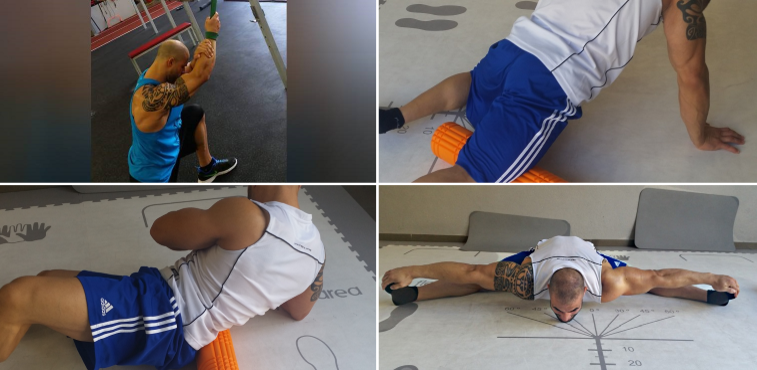
[:en]Mobility. All of us have it, some better than others. Truth be told, many people talk about it, but not many understand it.

It has to do with how much of the range of motion we have available we can actually do. This means that all of our joints have a limited range of motion. Perfect mobility would mean that someone could move that joint throughout its entire range.

Well, our life makes us create habits. Unfortunately, these habits don’t favor extremes of range of motion, meaning that our body “forgets” what it feels like to be in those extremes of the range of motion. Even worse, on the rare occasions in which our body ends up getting into those extremes of the range (imagine standing on the tips of your toes and doing a calf raise as high as you can, using only your body weight, where your foot will be at almost a 90º angle with your toes), it has reactions we don’t like, like slight pain or cramping.

Now, if we are n0t working our muscles throughout their entire range of motion, we’re probably not recruiting all the muscle fibers of that muscle.

Okay, it’s hardly impossible for anyone to have enough time to dedicate to achieving full range of motion in every joint. But it’s good if we can make improvements, small as they may be!

13051487_478124535730596_9062436776049263583_n

An obvious way is to stretch. Static stretching can help you feel more comfortable in reaching those extremes of the ranges of motion. But, for example, stretching before weight training can be prejudicial for power output, because it causes the muscles to loosen up. You want your muscles tense while you train. So it’s a good option for most workout, but maybe not pre.

Dynamic stretching can be more interesting, seeing as it’s more common for you to reach range of motion extremes while in motion, not statically. This means that practicing getting to those extremes with dynamic stretching will probably have a greater carryover to sports and physical activity in general.

As an alternative to these monotonous practices, Yoga classes, if done correctly, could seriously contribute to enhancing your flexibility and mobility as a consequence.

Then we have Active Release Techniques (ART), which can be done in a variety of ways. The foam roller and tennis ball have become increasingly popular in the fitness world, for example. But recently, their efficacy has been questioned. Many have even called it the biggest time waster of the fitness industry… Well. Let’s just say that getting work done by an ART practitioner might be more beneficial. This treatment will remove scar tissue, remove adhesions and make your muscles more relaxed. This will all facilitate the task of getting as close to a full range of motion as possible.

Essentially, what you need to do is move. There were some wise words once said to us that were as follows: “Move every joint in your body at least once a day. That’ll keep you out of a wheelchair”. This might be somewhat of an extreme statement, but hey, what “sayings” aren’t? Still the point remains. Move as much as you can, in as many different planes as you can! Get your body into places where it might not feel as comfortable! [:]


Para ter o melhor progresso possível no treino deve:

  • Estimular o músculo com frequência.
  • Entrar num programa de treino de acordo com a sua experiência e tempo de treino.
  • Focar-se na boa execução dos movimentos e escolher maioritariamente movimentos compostos.
  • Usar um método de sobrecarga progressiva.
  • Manter-se no mesmo esquema de treino por um bom tempo. Consistência é a chave para bons ganhos.

Quando o objetivo é construir massa muscular, existem vários erros que irão dificultar a obtenção de resultados.
A dieta e o treino têm de estar conciliados e estruturados para cada individuo. Neste artigo vamos deixar a parte da dieta de lado e vamos focar-nos no treino.

A nossa experiência de acompanhamento dos casos de pessoas que querem apenas fazer dieta, bem como de iniciados no fitness, ou mesmo de atletas, faz-nos deparar frequentemente com a mesma situação: Ou seguem o treino que está na moda ou o treino que lhe dão no ginásio e não evoluem.

Vamos analisar neste artigo os motivos pelos quais essas rotinas falham no que respeita a ganhos de massa muscular..

Antes de mais, o que definimos por treinos de bodybuilding?

Um treino de bodybuilding comum, é aquele treino típico que se vê há décadas nas revistas e nos ginásios e que reúne uma ou várias das seguintes características:

  • Treino de cada grupo muscular apenas uma vez por semana ( baixa frequência ).
  • Treino de 1 ou 2 músculos de cada vez.
  • Os músculos são expostos a um volume enorme de treino. Vários exercícios, séries e repetições com o objetivo de trabalhar o músculo de vários ângulos.
  • Cada série é geralmente feita com repetições altas (acima de 10 repetições por série).
  • Em algumas das séries, são usadas técnicas para ir além da falha muscular.
  • Bastantes exercícios de isolamento.
  • O objetivo é sentir o músculo a “queimar” e atingir o famoso pump muscular. Se tiver dores então, é espetacular!
  • Mudanças frequentes, para surpreender o músculo.

Identifica o seu treino aqui? Se sim, lamentamos informar mas tem andado a treinar de uma forma errada. Passamos a explicar porquê:

Erro nº1: Baixa frequência.

A pesquisa e a experiência baseada nos casos de sucesso, podem facilmente comprovar que este é o método de treino que menos ganhos trás a nível de força e muscular.

Se tiver uma genética incrível ou recorrer a uma grande quantidade de esteroides, irá certamente conseguir recuperar a quantidade de danos musculares gerados por uma rotina de treino tradicional. No entanto, os indivíduos comuns com uma genética normal, irão gerar elevados danos musculares, que ao fim de 7 dias, quando forem efetuar o próximo treino, ainda mal terão começado a construir massa muscular e continuarão a gerar novos danos.

Esta é a regra para o comum dos indivíduos e aplica-se a cerca de 90% das pessoas.

Existe sempre a exceção á regra. E se este for o seu caso, pense que poderia obter muito melhores resultados efetuando o treino corretamente.

Erro nº2: Combinações musculares perigosas.

Ao treinar um determinado músculo, irá treinar indiretamente outros músculos. Frequentemente observamos que nos ginásios há sempre pelo menos uma pessoa com problemas no ombro e que essa pessoa treina segundo o método acima descrito. A solução, passa por efetuar treinos com divisões musculares coerentes.

Erro nº3: Volume de treino mal dimensionado.

Por volume de treino, queremo-nos referir à quantidade de trabalho efetuado (peso, séries, repetições e exercícios por grupo muscular). A quantidade de volume tolerada é bastante individual, passando por vários fatores, incluindo: a idade, o tempo de treino, a genética, a alimentação, etc. Normalmente, um dos seguintes erros é responsável por retardar a evolução:

Pouco volume – Todos sabemos que quando maior for o volume de treino, maior será a construção muscular.

Volume adequado mas mal executado –  Verifica-se um bom volume de treino, mas onde a execução dos exercícios e a ativação dos músculos é péssima.

Demasiado Volume –  O treino está dimensionado acima das reais capacidades e características do indivíduo. São muitas as pessoas que treinam cometendo este erro.

Erro nº4: Demasiado foco no isolamento.

Os exercícios compostos (agachamento, peso morto, elevações, supino, overhead press) devem ser a base de qualquer treino. Os exercícios de isolamento devem ser sempre secundários. Podemos considera-los como exercícios acessórios. Muitas pessoas descartam os exercícios compostos em detrimento dos isolados, e exceto nos casos de problema físicos ou lesões especificas, esta opção é extremamente errada.

Erro nº5: Mitos de treino.

“Repetições baixas são para ganhos de força apenas”;

“Treinar sempre com repetições altas faz o músculo aumentar”;

“Exercícios isolados são para secar (perder gordura)”;

“Mudar constantemente de estímulos de treino a um determinado músculo adivinhar”;

Entre outros, estes são alguns exemplos dos mitos que impedem as pessoas de evoluírem no seu treino.

A chave está na consistência, no saber ativar devidamente o músculo durante o treino, progredir no treino e descobrir o volume ideal para o seu caso.

Erro nº6: Métodos avançados.

Os métodos avançados são para quem já está mesmo avançado no treino. Este não é o caso da maioria dos frequentadores dos ginásios. Superséries, drop sets, pré-exaustão, repetições forçadas, repetições parciais, negativas, etc., são técnicas para quem já não responde a outros estímulos. Chegar a este nível, demora vários anos de treino e não meses a acontecer.

Afinal como é que se constrói músculo?

  • Maior frequência de treino: treinar os músculos 3 vezes de duas em duas semanas, 2 vezes, por semana ou mesmo 3 vezes por semana é o ideal.
  • Usar uma partição de treino inteligente como: Upper Lower ou push pull legs.
  • Usar um volume moderado: onde se usam entre 20 a 60 repetições por grupo muscular em cada treino.
  • Usar uma seleção moderada de exercícios.
  • Basear o treino nos exercícios compostos.
  • Escolher bem os pesos: de modo a que consiga executar o treino todo, entre 5 e 15 repetições.
  • Tempos de descanso maiores param treinos com poucas repetições.
  • Progressão no treino. Este é o princípio mais importante de todos os programas de treino.

Esperamos ter conseguido esclarecer algumas das suas dúvidas e que agora possa perceber melhor porque o seu treino não está a resultar. Se precisar de ajuda, de encontrar um bom plano de treino adequados às suas características e objetivos individuais, não perca tempo e entre em contacto connosco. Teremos todo o gosto em ajudá-lo(a) a atingir os seus objetivos. Junte-se à Team Transformerz.

[:en]

[:]


logo site alternative light

Team Transformerz promotes a nutritional orientation approach that is both balanced and flexible, without fixed plans or restricted timetables. This way, everyone manages their meal plan each day, adapting it to his/her routine and preference!

Google & Facebook Reviews

TEAM TRANSFORMERZ™. All Rights Reserved.